Swinging Gate Motor Maintenance: How to Keep Your Gate Running Smoothly

In commercial sites, industrial facilities, and gated communities, a swinging gate motor is more than a convenience — it’s a critical security component. Neglecting its maintenance can lead to downtime, costly repairs, and safety risks. This guide walks through best practices for servicing, troubleshooting, and prolonging your swinging gate opener life in demanding environments.
Why Regular Maintenance Matters
Regular maintenance protects uptime, reduces unexpected repair costs, and keeps sites compliant with safety standards. For commercial, industrial, and gated community settings where gates can see hundreds of cycles per day, a planned servicing regime prevents small issues from becoming operational failures that disrupt traffic, deliveries, or tenant access. Routine care also preserves warranty coverage and supports predictable budgeting by converting reactive repairs into scheduled, lower-cost maintenance tasks.
Key Maintenance Tasks for Swinging Gate Motors
Here’s a practical maintenance checklist broken into recurring tasks:
- Inspect and tighten mechanical fasteners monthly to prevent loosening from vibration and wind load.
- Lubricate pivot points, hinges, and worm gears with manufacturer-recommended grease on a quarterly schedule to reduce friction and wear.
- Check electrical connections, control terminals, and sensor wiring for corrosion, tightness, and proper insulation during every service visit.
- Clean motor enclosures, venting and drainage paths to prevent dust, salt spray, and debris ingress that can accelerate failure.
- Verify limit switches, torque settings, and soft-start/stop parameters to ensure smooth motion and minimise stress on gearboxes and mounts.
- Test safety devices including photocells, entrapment protection, and interlocks at each visit to maintain compliance and user safety.
– Performing these tasks prevents premature component replacement and maintains reliable performance under intensive-use scenarios.
– Always engage a qualified technician to perform system diagnostics, motor load testing, control board checks, and full safety compliance testing.
– Note that after storms, high winds, or impacts, recheck your gate thoroughly — posts can shift, sensors misalign, and moisture can infiltrate housings
Troubleshooting Common Issues
Addressing the below issues early reduces downtime and the total cost of ownership for heavy-traffic installations. When diagnosing, always isolate the subsystem (mechanical, electrical, control) and work methodically. Make small adjustments and test repeatedly — avoid making large changes at once.
Symptom | Possible Cause(s) | Suggested Action |
Gate moves slowly, hesitates, or stalls | Increased friction, worn parts, misalignment, gear wear | Lubricate, tighten hardware, check alignment, inspect gearbox |
Motor overheating or shuts down | Overload, stuck leaf, poor ventilation, high cycle demand | Reduce load, clean vents, let motor cool, service internal parts |
Gate doesn’t reverse on obstacle | Faulty sensors, misaligned photo-eyes, or failure in inherent reversal | Test and realign sensors, check wiring, calibrate reversal logic |
Inconsistent or no response to remote or keypad | Wiring fault, receiver issue, interference, control board failure | Inspect antenna wiring, check receiver module, test alternate controls |
Gate leaf sagging or dragging | Foundation shift, hinge wear, bolt loosening | Adjust hinge settings, re-secure hardware, realign leaf geometry |
Gate drifts open or cannot hold closed in the wind | High Wind | Confirm motor holding torque and upgrade to higher-torque industrial operators or add mechanical locking devices such as motorised drop bolts for wind-prone sites. The combined use of a stronger motor with secondary locking solved wind-related failures in a recent apartment complex installation |
Excessive noise or vibration | Bolting of gearbox and other moving part | Inspect gearbox bearings, worn gears, and mounting brackets; tighten mounts and consider replacement of worn drive components. |
How to Extend the Life of Your Swing Gate Opener
These measures collectively reduce wear, improve reliability, and delay full motor replacement.
- Design for margin — overspecify motor capacity relative to gate size and expected use cycles.
- Optimal duty rating — choose motors designed for continuous or heavy-duty cycles in industrial/commercial settings.
- Weatherproofing — ensure motor housings, junction boxes, and seals are robust and protected against moisture, dust and pests.
- Surge protection and stable power supply — voltage spikes or fluctuations can degrade electronics over time.
- Load balancing — avoid overloading one leaf on dual gate systems; ensure both sides share stress evenly.
- Routine monitoring — track performance metrics, noise levels, cycle counts, and temperature over time.
- Timely part replacement — replace seals, bearings, and worn components before failure.
Choosing the Right Motor for Heavy-Duty Applications
In industrial or commercial settings, gate motors must meet more demanding criteria than residential units. Consider:

- Duty cycle rating: Opt for motors rated for high-frequency use and continuous operation.
- Torque & capacity: Factor in gate weight, leaf length, and wind load forces. Motors must handle worst-case conditions.
- Soft start/stop controls: Reduce mechanical shock by ramping motion, extending life of mechanical parts.
- Integrated safety and compliance features: Must include reliable obstacle detection, reversing, and compliance with local safety standards
- Robust housing & protection: Motors in industrial zones need stainless or corrosion-resistant enclosures, sealed wiring, and protection against environmental hazards.
- Backup power: In critical installations, battery or DC backup ensures operation during outages.
- Integration & control: Ensure compatibility with access control systems, sensors, and remote monitoring.
Rotech Automation’s Swing Gate Motor Solutions
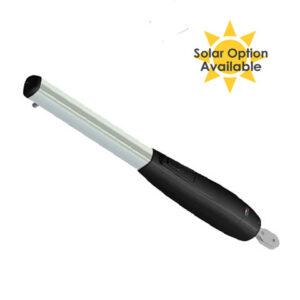

Whether you’re managing a large industrial facility, a multi-unit residential complex, or a secure commercial perimeter, Rotech provides the expert design, installation, and maintenance support your operation demands.
We offers a range of gate automation products engineered for different applications from residential to industrial, including heavy-duty operators designed for intensive daily use and adverse environments. Case studies show successful outcomes where carefully selected high-torque operators, combined locking upgrades and motorised drop bolts, solved reliability and safety issues in wind-exposed, high-traffic installations. Our guidance emphasises matching motor specification to site conditions, accounting for duty cycle, access control integration, and serviceability to deliver long-term cost savings and safer operation.
Bold maintenance routines, correctly specified motors, and targeted secondary locking will keep swinging gate motors running smoothly, reduce total lifecycle costs, and protect site safety and access continuity.
Maintaining a swinging gate motor is not a one-off task — it’s an ongoing commitment to reliability, safety, and performance. With a proactive regime of inspections, mechanical care, electrical checks, and appropriate equipment choices, you can significantly extend motor life, reduce downtime, and protect your investment.
By carefully selecting and maintaining the right swinging gate opener, you can enhance safety, improve revenue management, and optimise operational efficiency in your site. Do not hesitate to contact us for tailored advice.